
We Own the JW Fisher Pulse 8X — And We Know How to Use It
Brent Clevenger May 24, 2026
We Own the JW Fisher Pulse 8X — And We Know How to Use It
There are a lot of places you can read about the JW Fisher Pulse 8X. Most of what you'll find is marketing copy. This post is different — it's written by someone who first used one as a working public safety diver, then bought one for the store, replaced it when the time came, and now sells and rents it to divers across the Charlotte and Gastonia area.
The Pulse 8X is one of the tools we use on underwater recovery and search operations across the region.
If you're a certified public safety diver, a recreational diver who wants to try metal detecting on your next lake dive, or a fire or rescue department looking to evaluate gear, here's what you actually need to know. 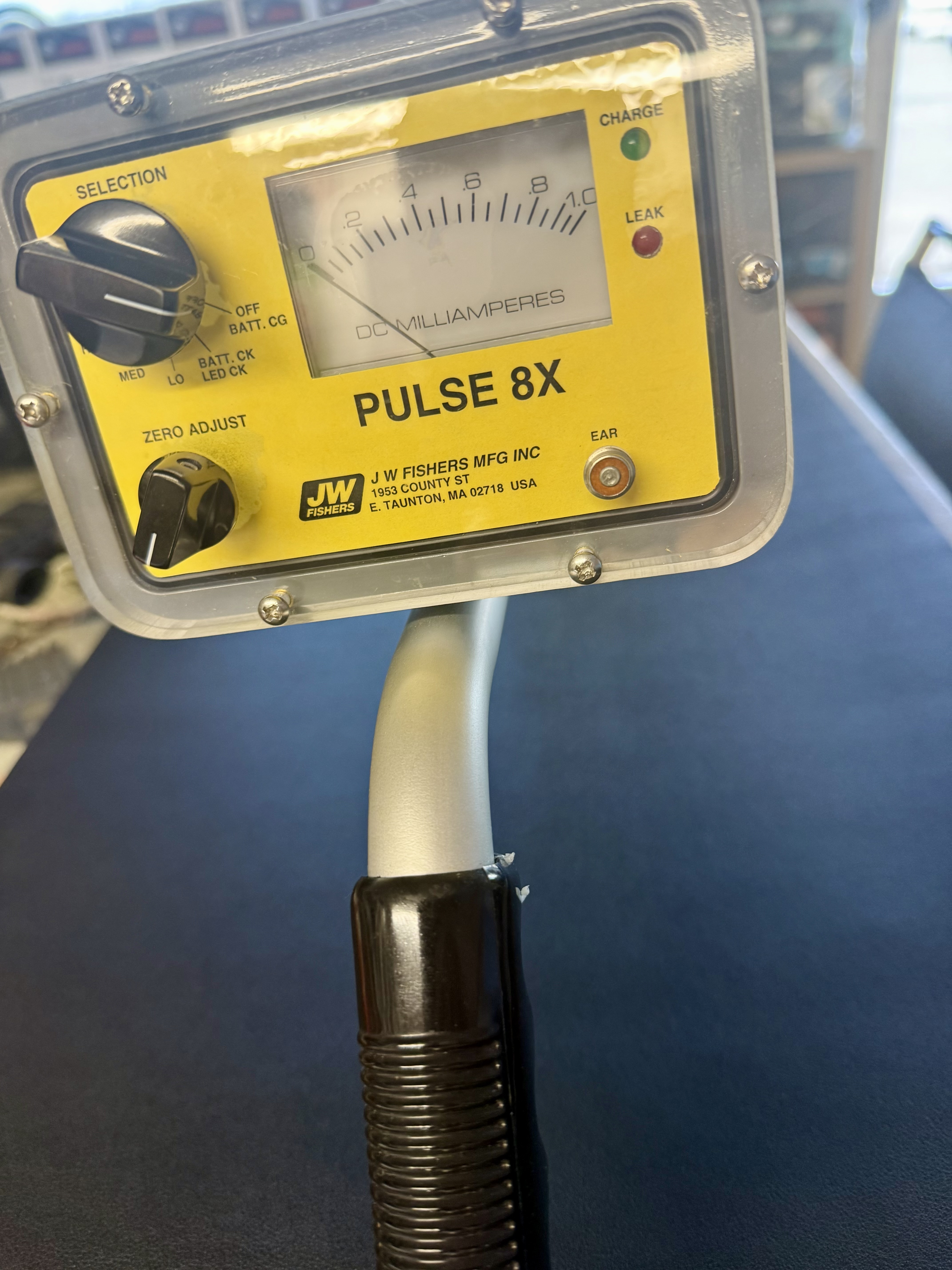
Why We Carry the Pulse 8X
Sink or Swim Scuba is an authorized JW Fisher dealer. We didn't become one by accident — we've stocked this specific detector because it's the one we trusted long before we ever sold a single unit.
My history with the Pulse 8X goes back to my time as a public safety diver. The department had one, and I used it on real operations — not a pool demo, not a pond with planted targets. I know how it handles in silt, in zero visibility, in current, and in the mineralized environments that make cheaper detectors completely useless.
When I opened Sink or Swim Scuba, buying one for the store was an easy call. That first store unit eventually needed replacing, and we bought a second. The one we have now is that second unit. Three Pulse 8Xs across two contexts — and every one of them has earned its keep.
When we decided to become an authorized JW Fisher dealer, the choice was equally easy.
What Makes the Pulse 8X Different
The Pulse 8X is a pulse induction (PI) detector, which matters a great deal underwater. Most consumer metal detectors use a technology called VLF (Very Low Frequency), which gets confused by saltwater, black sand, coral, and iron-rich environments. Pulse induction ignores all of that and focuses on the metal.
The result: the Pulse 8X will detect targets through air, freshwater, saltwater, silt, sand, and solid coral with no difference in performance between them. That's not a marketing claim — it's why the US Department of Homeland Security's SAVER program rated it the #1 underwater metal detector on the market.
Key specs worth knowing:
- Depth rating: 200+ feet
- Max detection range: up to 6 feet on large targets
- Battery life: 9–12 hours on a full charge
- Buoyancy: slightly negative — it sits on the bottom while you dig, instead of floating away
- Construction: solid-cast housing, ¼" wall thickness, ½" acrylic faceplate secured with six stainless steel screws
- Indicators: both audio alarm and a visual signal-strength meter — useful for estimating target size and depth
The audio alarm is loud enough to hear clearly through an underwater earphone. The meter is what separates the Pulse 8X from lesser PI detectors — the needle deflection gives you real information about how large the target is and how close you're getting to center.
Coil Options and What They're For
One of the most overlooked features of the Pulse 8X is its coil system. The standard 7.5" coil handles the majority of dives well — it's sensitive to both small objects (coins, rings, shell casings) and large ones, and it's easy to pinpoint with.
But the optional coils open up a completely different set of use cases:
5" coil — Best for high-trash environments where you need to narrow your detection cone and pinpoint small targets without false signals from surrounding debris.
7.5" coil (standard) — The all-purpose workhorse. Use this for 90% of recreational and PSD dives.
10" coil — More ground coverage per sweep. Good for open, clean bottoms where you want to move faster.
16" coil — Deep targets: buried anchors, large weapons, vehicles. Wider detection pattern for grid searches.
18" coil (boat deployment) — The electronics stay on the boat while the coil drags on the bottom. One operator can cover a large area from the surface without ever getting wet.
8" × 48" sled with 100' cable — Full boat-tow platform. The skids protect the coil from bottom contact. Suitable for high-speed towing and large-area surveys.
Probe coil (1" × 22") — For getting into crevices, wreck interiors, and confined spaces where a standard coil won't fit. Ideal for evidence recovery in tight environments.
Important note for buyers: The coil-swapping connector is a separate $175 add-on. Without it, the unit is permanently hardwired to the factory 7.5" coil. If there's any chance you'll want to use additional coils later, add the connector when you purchase — installing it after the fact requires sending the unit back to the factory.
How It Integrates with Surface-Supplied Diving
One thing worth noting for our public safety and commercial diving clients: the Pulse 8X pairs naturally with surface-supplied diving configurations, including the Interspiro DP-1 system with an Interspiro AGA mask or a Guardian mask.
When you're working on the surface-supplied umbilical — with communications, air supply, and a tender topside — you have both hands free to work the detector methodically. There's no managing your own gas supply or buoyancy corrections pulling your attention. You can maintain a clean, systematic grid pattern that just isn't possible the same way on SCUBA.
For public safety dive teams that operate with the DP-1's auto-switching backup system, this is a meaningful workflow advantage. The diver focuses entirely on the search; the tender tracks position, progress, and gas supply from the surface.
As the exclusive Interspiro distributor for North Carolina and South Carolina, and an authorized service center for both Interspiro and OTS equipment, Sink or Swim Scuba is uniquely positioned to help agencies outfit a complete surface-supplied search-and-recovery capability — detection hardware included.
Available at Sink or Swim Scuba: Demo, Rental, and Sale
We currently have the Pulse 8X available for demo, limited rental, and sale.
Demo: If you're a fire department, rescue team, or dive team evaluating equipment, contact us to arrange a hands-on demonstration. We'll walk you through the detector and, where possible, get it in the water with you.
Limited Rental: We offer rental of the Pulse 8X to certified public safety divers and, depending on the situation, other certified divers. Contact us to discuss availability and requirements. Rental is not walk-in — we want to make sure the unit ends up in the hands of someone who knows how to use it and can return it in the same condition.
Sale: We sell the Pulse 8X as an authorized dealer, complete with the full manufacturer package and JW Fisher's unconditional two-year warranty. We can also help you select the right coil configuration for your use case and ensure you have the underwater connector installed before the unit leaves the shop.
Pricing varies depending on configuration and accessories. Contact us directly for a quote.
Who This Detector Is For
Public safety dive teams — Law enforcement, fire, and rescue dive teams use the Pulse 8X for weapons recovery, evidence searches, and underwater grid operations. It's what the FBI, Secret Service, US Navy, and Coast Guard use. If it's good enough for them, it's good enough for your department.
Recreational divers looking for adventure — Lake Norman, High Rock Lake, Lake Wylie, and dozens of other local lakes and rivers have decades of lost jewelry, coins, and artifacts sitting in the silt. If you've got your Open Water certification and want to try something different on your next dive, this is the tool.
Wreck divers and salvagers — North Carolina's coast has some of the most historically significant dive sites on the East Coast. The Outer Banks is known as the Graveyard of the Atlantic. The Pulse 8X was built for this environment.
Commercial divers — Pipeline inspection, marine construction, infrastructure surveys — any time you need to locate or confirm the presence of metal on the bottom, this is the professional-grade tool for that job.
The Thing Nobody Tells You: Welcome to Can Tab Lake
Here's something the product page will never say, but that anyone who has actually used an underwater metal detector in a popular swimming or fishing spot already knows: you will find trash. A lot of it.
The Pulse 8X detects all metals. That is one of its greatest strengths — it won't miss a firearm because it decided to discriminate against ferrous targets, and it won't ignore a spent shell casing because it looked like junk on the signal profile. What it will also do, with complete enthusiasm, is find every bottle cap, every fishing weight, every rusted hook, and — most of all — every aluminum pull tab from every can of beer ever cracked open on a boat dock since approximately 1965.
I've pulled hundreds of can tabs off the bottom of local Carolina lakes during actual evidence searches. Hundreds. You work a grid, the detector screams, you fan the silt, and up comes another pull tab. Then another. Then a bottle cap. Then, if you're lucky, the thing you were actually looking for.
This is not a criticism of the detector — it's the reality of what's down there, and the Pulse 8X is just doing its job honestly. There are detectors with discrimination modes that try to filter out aluminum and iron to show you only "good" targets. The problem is that discrimination dramatically reduces detection range and causes you to miss real targets. JW Fisher deliberately does not put discrimination on the Pulse 8X for exactly this reason — in testing, discrimination reduced coin detection range from 6 inches to less than 3 inches.
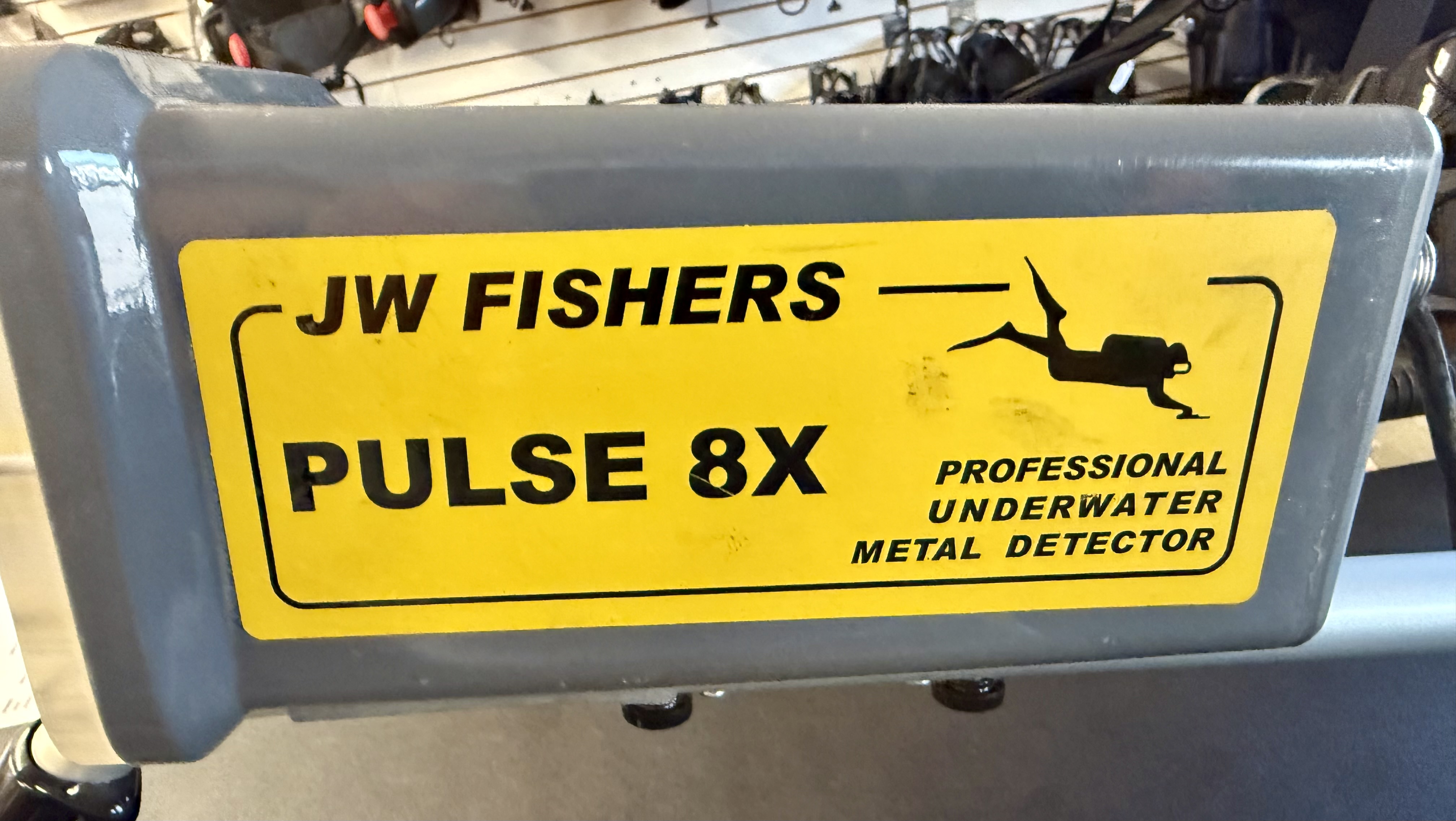
For recreational treasure hunting, trash is just part of the game. For public safety diving, there is no alternative — you cannot afford to miss something because the detector decided it probably wasn't worth investigating. You dig everything. Every signal. Every time.
The practical upside: the more trash you pull out of a lake, the cleaner the site becomes for the next search. We'll call it a public service.
A Few Operational Tips From Experience
The manual covers the basics, but here's what it doesn't tell you clearly:
Start on LOW sensitivity, always. Even in clean freshwater, beginning your session on LOW and working up to MED or HI gives you a baseline before you commit to higher sensitivity. In salt water or black sand, you may need to stay on LOW or MED the entire dive to avoid false signals.
The meter tells you more than just "there's metal." The needle deflection indicates target size. A small deflection from a large coil means the target is either small or far away. Learn to read it.
When the meter pegs full-scale, back off. If you get too close to a large target, the meter maxes out and may stay there for several seconds even after you move away. Lift the coil up, increase your distance, and re-approach slowly.
Hip-mount the electronics housing when digging. The housing detaches from the arm rest with two thumbscrews and rides on a belt around your waist. Freeing both hands makes a real difference when you're fanning silt or using a lift bag.
Heat is the enemy of the seals. Don't leave it in a hot car or in direct sunlight. The seals can fail and the electronics can be damaged. Rinse with fresh water after saltwater use.
Come See It
We're located at 4310K Wilkinson Blvd, Gastonia, NC 28056 — serving the greater Charlotte and Gastonia area, with clients across North and South Carolina.
Hours: Wednesday–Friday 10am–6pm | Saturday 11am–6pm
Phone: (704) 823-0501 | Direct: (704) 823-0502
Email: Dive@SinkorSwimScuba.com
Website: www.SinkOrSwimScuba.com
Whether you want to hold one in your hands, get a demo in the water, or sit down and talk through what configuration makes sense for your team or department — we're here. This is what we do.
Sink or Swim Scuba — Voted Best Dive Shop in Charlotte, 2025. Helping Divers Explore & Train with Confidence.
Related Resources
- ERDI Public Safety Diver Training
- Public Safety Diving Equipment
- Underwater Search and Recovery Equipment
- Interspiro Public Safety Diving Equipment
- Contact Sink or Swim Scuba for JW Fisher Pulse 8X demonstrations
Who Uses the JW Fisher Pulse 8X?
- Police dive teams
- Sheriff’s office dive teams
- Fire department dive teams
- Search and recovery teams
- Recreational treasure hunters
- Lost item recovery divers
Related: our authorized Interspiro distributorship, request a dive-team equipment quote.
